
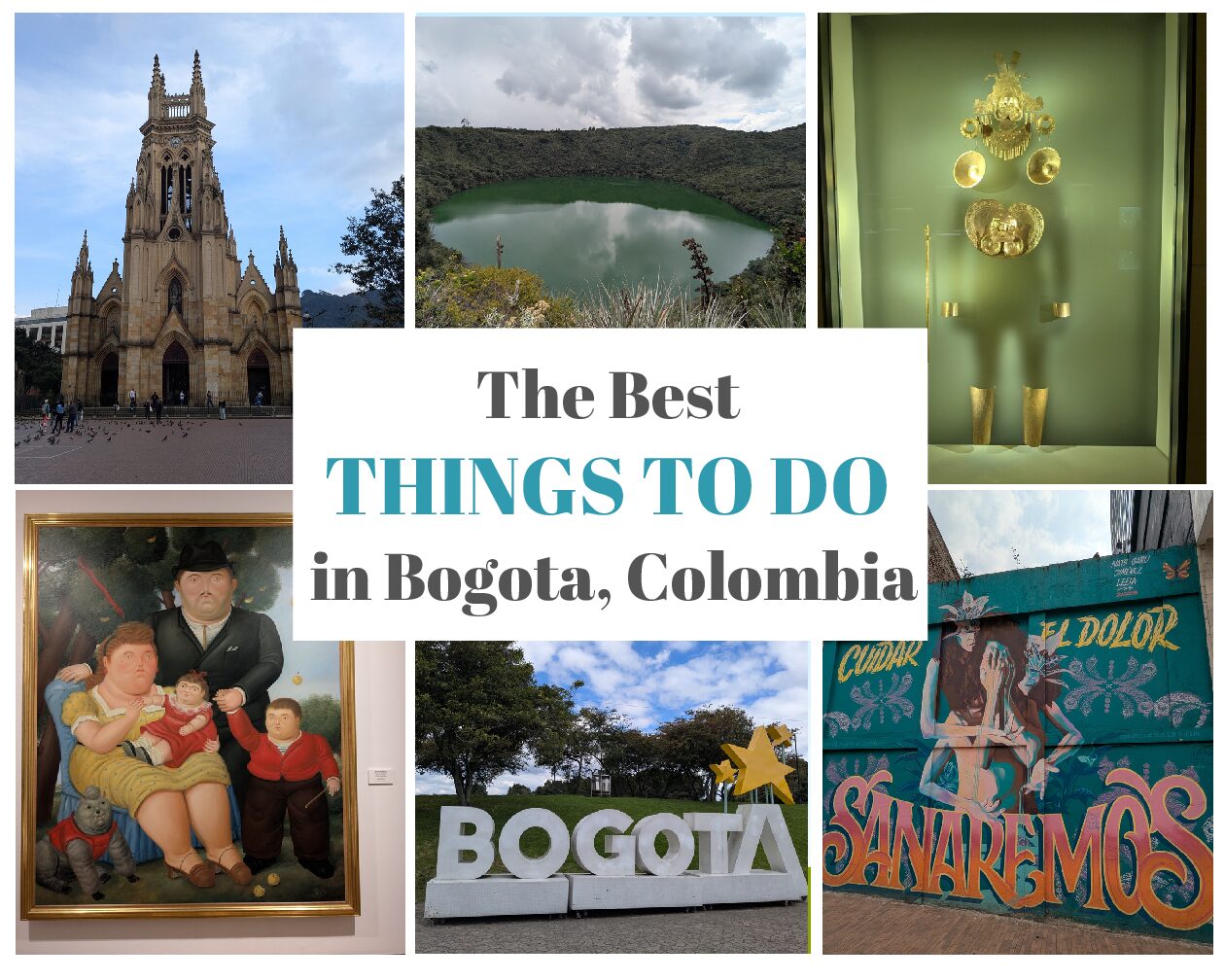
The Best Things to Do in Bogotá, Colombia
This post might contain affiliate links. That means I may earn a small commission at no extra cost to you, if you buy through my site. I appreciate your support of my site.
When visiting Colombia, many people only spend a few days in Bogotá, or skip the city altogether. I spent the most time in Colombia’s capital city! Even though the more touristy and digital nomad friendly cities of Cartagena and Medellin are often chosen over Bogotá, I quite enjoyed the biggest city in the country. Definitely leave at least a few days in your Colombia itinerary to visit Bogotá.
You don’t need to wonder what to do in Bogotá. This guide includes the best things to do in Bogotá from free tours, to museums, to outdoor experiences, to day trips. Check out my Bogotá restaurants post to discover where to eat. For additional tips on visiting Bogotá and where to stay, read my full Colombia itinerary (coming soon).
The Best Things to Do in Bogotá
Free Tours in Bogotá
I love free walking tours! If a city has one, it’s a priority for me to add it to my itinerary. If a city has five, you can bet I am doing all of them! That’s exactly what I did in Bogotá. Not only are you able to see the sights, but you are also learning about the history and culture of the city from a local. Museums are great for learning, but many of the Bogotá museums are only in Spanish. The free walking tours are all offered in English. Plus tours are a great opportunity to meet fellow travelers.
There are several different companies that offer tours. I have noted below which company I used for each tour. I do love free tours, but while I went on all five tour types, I didn’t go on the same tour with every company! All the tours below cover different routes and topics so you can easily join them all like me! Taking free walking tours is definitely one of the best things to do in Bogotá.
Most of the Beyond Colombia and the Capital Graffiti tours begin from el Museo del Oro. The museum may or may not let you use the bathrooms before the tour. One time I had no problem and another time I talked my way into them letting me!
The Gran Colombia Tours begin near Plaza Distrital de Mercado La Concordia, which has free restrooms.
Each tour is free, but tips are appreciated at the end.
Downtown Walking Tour

Beyond Colombia Tours and Gran Colombia Tours both offer versions of a tour of La Candelaria focused on the history of the country.
Beyond Colombia’s downtown walking tour was one of the first things I did in my Bogota itinerary. Out of all the free walking tours I chose to take this tour first, and you should too, because it gives the general history of Colombia. The country’s history from the beginning is shared, including that of the Muisca, the indigenous people of Colombia. Not only will you learn about chicha, their traditional drink, but you’ll get a taste for yourself!
As you tour La Candelaria, the historic center, you’ll learn about other important events, places, and people through stops at some of the most significant plazas and buildings. While there was a lot of information shared, it was in small chunks at different stops. As the tour guide was very engaging, I never found my mind wandering.
There is a bit of local information and tips thrown in too. The tour ended with recommendations of what to eat in Colombia. Throughout the tour our guide was very open to questions.
The tour is about three hours long and begins at el Museo del Oro and ends at el Centro Cultural Gabriel García Márquez. There is a break with free restrooms about 2 hours into the tour at the Plaza de Mercado La Concordia.
Colombian Conflict Tour

Before planning your trip to Colombia your friends and family probably expressed a lot of concern about your safety. The Colombia of today is quite different from the Colombia of 100, 50, and even 10 years ago. The Colombian Conflict Tour by Beyond Colombia tours is your chance to really learn about the civil wars, years of violence, drug cartels, assassinations of political leaders, and ultimately how a peace agreement was signed.
Like the tour above it is also in La Candelaria, but it covers a different route. Not only will you see different sites, but you’ll also learn different content. It’s smart to do this one after the general history walking tour. While the tour above gives a few details about the many years of conflict in Colombia, this tour really dives deep into it.
My guide was very knowledgeable. The tour was far from scripted and the guide was more than willing to expand on any topics. There are quite a few long stops with a lot of information shared, but there is a lot to learn!
The tour is scheduled to be three hours long, but our tour was slightly shorter. It begins at el Museo del Oro and ends at el Teatro Colón. About an hour and 20 minutes into the tour there was a 20 minute break. The break was near coffee shops. The guide let me go into one of them with him so I could use the restroom without needing to buy anything.
Graffiti Tour

There are several tour providers that offer a graffiti tour. I went with Capital Graffiti Tours as they are directly involved in the Bogotá street art scene. This tour is also in La Candelaria and begins from el Museo del Oro. Although it was the third tour I took in La Candelaria, I still saw new sights.
The tour begins with a brief overview of graffiti in Bogotá. Then there are several stops at really cool murals. It’s the perfect tour for street art enthusiasts. It is so much more than an art tour though. It worked really well after the conflict tour as several of the murals referenced different themes or events in Colombia’s turbulent history.
Many of the murals also showcased typical things from Colombia’s culture. It was a fascinating way to learn more about the city and country. The murals were definitely spectacular, but the tour was just as much about history, culture, and politics as it was about art.
There are no bathroom breaks on the tour, but after about 2 hours you’ll reach Ocio Gallery where you can use the restroom. At the galleries there is an art demonstration and a fun hands on activity that I won’t give away! The tour wraps up in the gallery where you can look at and even buy local art. A portion of your tips for this tour go directly to support the local street artists.
Chapinero District Tour

This tour is offered by Beyond Colombia. It is the only free tour outside of La Candelaria. You definitely want to save this one for last or second to last if you are doing all the tours as it covers recent Colombia culture and only makes a few references to the country’s past. It helps if you have already learned about those topics to better understand why the country is the way it is today.
This tour through Chapinero wasn’t as packed full of information as the other tours. It includes snippets of stories and details about more recent places and life in Bogotá. A big focus is on the contrasts within Chapinero District. It’s a good way to explore a different part of the city and learn how this area started.
The tour begins from el Parque de Los Hippies. There is a stop about an hour and half into the tour at a shop where you can have a cacao leaf tea sample. There are restrooms at the shop. The tour ends at Librería Wilborada, a book shop and cafe. It has restrooms.
Local Food Tour

Last, but certainly not least, is the most delicious walking tour. Beyond Colombia offers a free food tour in La Candelaria. Food tours are often quite pricey so I love the rare times when a city has a free food tour. Like all free tours you are expected to tip at the end and you need to buy your own food. I spent around $8 USD on the food I bought during the tour. It’s so much better than a food tour where everything is included, because you don’t need to buy or eat anything that doesn’t appeal. I don’t like cheese so I had no interest in trying the famous Colombian chocolate with cheese!
Unlike the other free tours that involve a lot of information, this one is focused on enjoying the food. There are a lot of opportunities to talk with fellow tour goers. The tour includes five stops with local foods and/or drinks. I’m not going to give away all the foods and places we stopped. You’ll need to take the tour for yourself! The food was good, but I didn’t find there was as much food as in a lot of other food tours I have done. There was also just as big of focus on drinks as there was on food.
The food tour can be done at any point within the other free tours, but I saved it for last. If you have a shorter time in Colombia you may want to book it earlier so you can learn about local foods and have more time to order the ones you like after the tour.
Stops #2, #4, and #5 all have a restroom. All stops except #3 take credit cards.
Museums in Bogotá
Bogotá is a major cultural hub in Latin America. Museum lovers will be overwhelmed with options in Bogotá. Make sure to check the hours before visiting, many museums are closed on Mondays. All the museums have free restrooms.
Museo Botero

El Banco de la República has five museums in Bogotá. Museo Botero is one of the five and is part of a complex of three connected museums. It is the most well known of the three and primarily features the works of Fernando Botero. He passed away in 2023 in Monaco as a very wealthy and world-wide famous artist. That is very rare for artists, especially from Latin America. He donated his works to the museum in Bogotá with the stipulations that the museum is always free (yay) and that the artwork can’t be changed or rearranged in any manner.
Most people would say he sculpted and painted “fat people”, but he insisted that he created people and objects that were at an exaggerated scale. It is an interesting style. Rooms at the museum are full of his work as well as artwork from Botero’s private collection. It includes art by Picasso, Gustav Klimt, Henri Matisse, Claude Monet, and more.
There are no descriptions on the artwork other than the artist, title of work, and the materials used to make it. It was a good vocabulary lesson if you’re learning or practicing Spanish, but you don’t need to know Spanish to visit.
Museo Casa de Moneda

This is another free Banco de la República museum that is connected to el Museo Botero. The museums are connected without having to leave the complex.
The museum is all about the history of money in Colombia. Make sure to start on the lower level in the first room as the exhibits go chronologically.
Each room has an overarching description in English and Spanish. The rest of the written information is in Spanish only. Even if you can’t read Spanish, art museums are still easy to enjoy. Here there are visuals throughout the museum, but there is so much history to learn that it really helps if you can read some of the descriptions. It’s definitely an interesting way to learn about a country’s past through its currency. Check the schedule for guided tours in English.
Museo de Arte Miguel Urrutia -MAMU-

This art museum is the final museum in the complex of three. The permanent collection is divided into five centuries of art. It features art from Colombians, other Latin Americans, and Europeans.
Temporary exhibits cover a wide range of topics. There is also a fun interactive exhibit for kids of all ages. There are very few descriptions in English. The majority of the written information is in Spanish.
Depending on how much time you take in each museum, expect to spend about 3 hours if you would like to visit all three museums. The courtyards in between are a lovely place to take a break as well. There is also a restaurant in the Museo de Arte Miguel Urrutia -MAMU-.
Museo del Oro

Another Banco de la República museo, but in a separate location, is the museum of gold. Visiting the gold museum is one of the best things to do in Bogotá for visitors who don’t speak Spanish. It’s the only Bogotá museum I went to that had all the writing in both English and Spanish. Both the overarching exhibit descriptions and individual descriptions throughout the exhibits were in both languages. There are audio guides available for an additional charge too.
It’s also a great museum to visit because gold is such an important part of the country’s history. Through four main exhibits the history of gold and other metals is told. The museum is full of artifacts and descriptions of how they relate to the early indigenous cultures of Colombia.
The museum isn’t organized in chronological order, but it does make sense to follow the direction the museum recommends. You’ll start on the second floor with the exhibit on the working of metals. Then you’ll continue to an exhibit about people and gold in pre-hispanic Colombia. Next you’ll head to the third floor to learn about cosmology, symbolism, and offerings.
As many of the free tours begin in front of the museum, this is a great place to visit before a free walking tour. Going to the museum in the morning for a couple of hours and then doing the food tour for lunch works well.
Casa Gómez Campuzano
This is the fifth and final Banco de la República museo in Bogotá. It is an extension of the Luis Ángel Arango Library. It also includes artist Ricardo Gómez Campuzano’s collection.
It was closed until March 2026 so I wasn’t able to visit.
Museo Nacional

I unfortunately ran out of time to visit this museum. It is one of the most popular museums in Bogotá so I wanted to give it a quick mention.
Located in a former prison the museum is the country’s oldest. With a collection of over 20,000 objects it is also the largest.
Reviews are mixed about the museum. It isn’t expensive by US standards, but it does charge the highest admission compared to other Bogotá museums. Many non Spanish speaking visitors mention the absence of English and the lack of a sensible exhibit organization.
Hopefully someday I will be able to return to Bogotá and visit it. In the meantime if you go, leave your thoughts in the comments below!
Museo Quinta de Bolívar

The museum is the former home of Simón Bolívar, a military leader involved in the war for independence in South America from Spanish rule.
While it is a lovely home surrounded by beautiful gardens, it is quite small. I’m glad I visited during the free hours. There were no audio guides available. They usually can be rented for an additional cost. That may have added to the experience. There was also very little written information, even in Spanish. There’s more information on the website than at the museum.
Due to a downpour, which is quite common in Bogotá, I stuck to the house and didn’t get to walk around the gardens. I would have liked to do that.
The museum is located near the base of Monserrate, described below. Visit the mountain in the morning and head to the museum in the afternoon. If possible, time your visit for a Wednesday between 3 – 5pm so you can enter for free.
Museo del Chico

This is a small museum that doesn’t draw the tourist crowds like the museums above. The location in Chapinero was what initially attracted me to the museum as I could walk from my apartment in Usaquén. If you’re staying in La Candelaria it’s a good excuse to head north and see more of the city.
The museum is located within a park that can be visited for free. It’s a breath of fresh air away from the overwhelming amount of traffic in Bogotá. There is a small admission fee to the museum that you pay at the main gate. Restrooms are free within the white building to the right after entering.
The museum is in the colonial building to the left after entering. It’s a historic building with a lovely courtyard in the middle. The courtyard is the only place you can take photos in the museum.
Surrounding the courtyard are small rooms with art and antiques. There is a room with glass, another with porcelain, one with religious objects, and a room with a set dining room table. There are also two rooms from Doña Mercedes Sierra. She collected the majority of the pieces that now make up the museum. One of her rooms is a beautiful yellow and blue tile bathroom.
Every room has a written description in Spanish. While there are a few other descriptions for specific objects, it’s a good museum if you enjoy looking at historical objects.
Note that the park is open from 9am to 5pm, but the museum closes in the middle of the day from 1 – 2pm. I visited the museum in less than an hour and I am usually pretty slow at museums. I saw another man spend only 15 minutes in the museum.
Outdoors in Bogotá
The weather might have a chance of rain forecasted every day, but unless you’re visiting during a rainy season you will be pleasantly surprised with the mild weather.
Monserrate

Mountains border the eastern side of Bogotá. They are a great landmark if you’re trying to get your bearings in the city. Monserrate is one close to La Candelaria that you can go to the top by funicular, cable car, or by foot. Whatever mode of transportation you choose, the epic views from the top make going up Monserrate one of the best things to do in Bogota.
Both the funicular and cable require a paid ticket. It is free to hike. You can do one way to the top and another way to the bottom or the same way in both directions. Hiking up is available from 5am to 1pm. Hiking down is available until 4pm. The hiking trail is closed Tuesdays.
As an avid hiker I wanted to hike up and down. Before I made my trek up the mountain on foot I asked numerous locals if it was safe to hike alone. Everyone said it was definitely safe, but it was challenging. They were much more focused on the latter and they were right! On a weekday, late in the morning, it was very busy. I never felt unsafe. On the way up I never went more than a few seconds before I saw someone. As I headed back down after 1pm it wasn’t quite as busy, but I still felt safe. I’m definitely glad I went on a weekday instead of a Sunday when it’s apparently packed. It’s not necessary, but if you want more people around I would start the hike around 9am or 10am as then there are a lot of people in both directions.
The hike up is a gazillion uneven stone stairs the whole way. Sources say different numbers online and I wasn’t going to spend my whole hike counting so gazillion is accurate enough! I thought I was going pretty good and then realized I was only 1/5 of the way there. Signs along the way show your progress. If you’re struggling you may not want to look! If you’re coming from a sea level destination and not used to altitude, give yourself a few days in Bogotá before attempting the climb. Also avoid hiking on a rainy day as the steps get very slippery.
There are food stalls throughout the trail selling drinks and snacks. There are also bathrooms about 1/2 way up. You have to pay to use them. There are also bathrooms near the funicular station at the bottom and at the top. Those also require a fee, but are nicer than the ones on the trail. There are free port a potties at the bottom across the street from the hiking trail.
At the top there is a church, a bird walking trail, and restaurants. Of course the real draw is the amazing panoramic views of Bogotá.
Parque Metropolitano Simón Bolívar

There are two places I always love to visit in any country, a grocery store and a local park. Both places are a great way to get a feel of the city and become absorbed in the daily life of the city you’re visiting outside of the usual tourist attractions.
Simón Bolívar park is the city’s largest park. There are numerous paths around the park for a walk, jog, or bicycle ride. There are some narrower pedestrian only paths with a red dirt terrain. With the crazy traffic and uneven sidewalks in the city it is nice to get away and enjoy a walk without constantly watching where you are going. Like everywhere in Bogotá you should still be aware of your surroundings though.
There are several playgrounds and a big lake in the middle that offers canoe and pedal boat rentals. Stationary food vendors can be found throughout the park.
Bathrooms are free, but you need to bring toilet paper.
Parque de la 93

This is a really small park in the neighborhood of the same name within the larger Chapinero district. It’s a lively area that is overall very safe and full of restaurants and shops. The park is a fairly small rectangle, but it’s worth a stroll around if you’re in the area.
The park and surrounding area is a nice area to explore. There is also Parque el Virrey nearby which is a linear park.
El Mercado de las Pulgas de Usaquén

Every weekend in Usaquén there is an outdoor flea market. It may be called a “flea market”, but I would consider it an artisan market. The majority of the stalls are selling handmade items. You’ll find everything from jewelry to paintings to chocolate. It’s a good place to buy a souvenir if you have enough space in your suitcase, unlike me!
Market stalls fill several blocks of streets. In between the vendors there are often musicians performing, artists creating, and performers doing any sort of activity. When I visited I saw some great chalk art, a man sitting as a gold statue, and a lady singing Shania Twain!
If you need a starting point, begin at Hacienda Santa Barbara, a mall that is next to the market. It is not your typical suburban mall. It is a winding maze of shops and places to eat divided into zones. There is a food court with a lot of options. Find the free restrooms in zone F.
Day Trips from Bogotá
While there are many cool things to do in Bogotá, it’s great to also get outside of the city and experience the beautiful nature in Colombia. Guided day trips are an easy way to see more of the country without figuring out all the details yourself or needing to change your accommodations.
While I only had time for the first day trip from Bogotá below, I shared a few other popular choices. They are all highly rated tours.
Zipaquira Salt Cathedral and Guatavita Lake Day Tour
On the Zipaquira Salt Cathedral and Guatavita Lake Day Tour you’ll visit two very interesting places north of Bogotá.
Guatavita Lake

The first is Guatavita Lake. The lake is sacred to the Muisca. The indigenous group performed ceremonious rituals in the lake which involved gold offerings. This started numerous expeditions to uncover the gold.
The lake is now a protected site. On your visit you’ll take a guided hiking tour to the viewpoints above the lake. It’s a short hiking trail, but it is steep with about 150 uneven, rocky stairs. Luckily there are many breaks to catch your breath and learn more about the history.
Salt Cathedral

The Salt Cathedral is the other main stop. Here you will have about 3 hours to explore on your own with an audio guide in several different languages. Known as Colombia’s first wonder of the world, the salt cathedral is an underground church in a functioning salt mine. The audio guide left a bit to be desired, but it is a really unique place.
Although we drove through Guatavita, we did not stop there like the description said we would. Perhaps we were behind schedule and this stop was eliminated. There was a lunch stop in Zipaquirá. My fellow tour goers weren’t too nuts about the food. It wasn’t my best meal in Colombia, but it certainly wasn’t the worst.
Tour Details

The tour lists the amount of walking at 1.55 miles (2.5km), but I was at 8.6 miles (13.84km) by the time I returned home at night! You can book the full day tour with or without entrance fees.
Pick ups and drop offs are also included. There is quite a bit of driving. The total drive time depends on your location and your luck with the locations and number of pick ups. Pick ups start in the south and continue north. Someone in my group was picked up at 7:20am. The last pick ups in Usaquén, where I was staying, were at 9:10 and 9:20am. Several people had to drive around in Bogotá for two hours before the drive to our destinations even started!
There is 4 or 5 hours of driving after leaving Bogotá and before returning back (between the stops). It’s not to discourage you from doing the tour, but only to set expectations. You may also want to take this into consideration when you are deciding where to stay.
There is a bathroom stop about 30 minutes after leaving the city. Restrooms are available at Lake Guatavita upon arrival and about 2 hours later before leaving. Then there is a restroom at the restaurant after a 90 minute drive. The salt cathedral is close to the restaurant. Restrooms are on the plaza before and after entering/leaving the salt cathedral. Within the cathedral they are only in one spot in a quite inconvenient location. You can access them at any time, but they are far away from the entrance. That probably added at least an extra mile to my step count!
While I’m sure the timeline varies based on group size, pick up locations, and traffic, our lunch wasn’t until after 3pm. There are two stops with options to buy something quick to eat before that. No food is allowed in Lake Guatavita, but they don’t check too closely. I of course respected the no eating in the park, but I pulled out my granola bar at the end by a food stand instead of buying something.
If you want a shorter day with less walking and/or drive time you can do a day trip to only the salt cathedral.
Villa De Leyva Day Tour
Declared a National Monument in 1954, Villa De Lyva is a colonial Spanish town built in 1572. On this full day Villa De Leyva day tour you’ll drive through different landscapes, explore the town, and have entrance to the Paleontological Research Center Museum.
La Chorrera Waterfall Guided Hike
This tour includes a guided hike to the tallest waterfall in Colombia.
Half-Day Coffee Farm Tour
Have a hands-on experience at a local coffee farm on this half-day tour.
You don’t need to wonder what to do in Bogotá any longer. If I helped you plan the best things to do in Bogotá, please consider supporting me by Buying Me a Coffee.
More About Colombia
Pin It!!



You May Also Like

2 Comments
Ryan Biddulph
What a rich guide here. Fab job.
Bogota looks like a colorful, fun city to visit. The Conflict deal would be intense but fascinating too. Much complexity in that country at times; especially from the drug trade.
I too would enjoy those free walking tours. About my favorite thing to do in any city.
The Fearless Foreigner
Thanks! Colombia definitely has a turbulent, but interesting history.